
Property Questions
Why Does Interlock Sink?
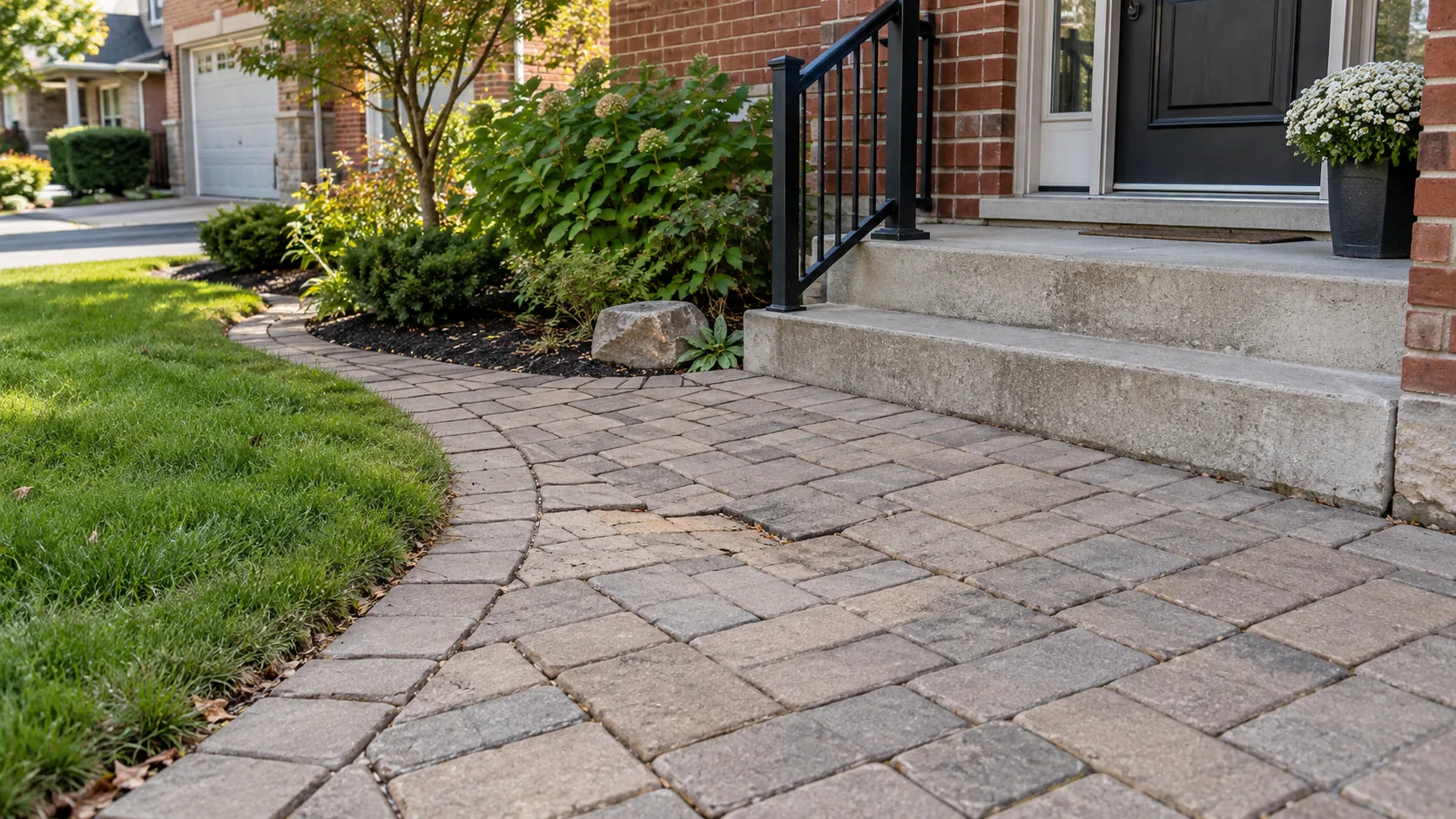
Sunken pavers are a visible symptom of movement below or beside the surface. The pattern of settlement helps identify the next questions about support, water, loading and edges.
Interlock sinks when part of its supporting system moves, loses support or no longer holds the units in position. The paving blocks may remain intact while the ground, aggregate base, bedding or edge beneath them changes. That is why replacing a few visible blocks does not necessarily address the reason they moved.
The shape of the problem is useful evidence. A wheel-path rut, a dip beside a porch and a spreading outside border suggest different questions. None can be diagnosed confidently from appearance alone. Begin by describing where the movement occurs, how it has changed and what happens there during rain or ordinary use.
Read the pattern before naming the cause
Look at the whole paved area from a position where its edges and fixed connections are visible. Is the depression isolated, repeated along a driving line or spread across most of the surface? Check the relationship to a stair, wall, driveway apron or drain. An abrupt change beside a stable feature can make small movement much more noticeable.
Compare the low area with the surrounding joints. Tight, relatively even joints around a bowl-shaped depression tell a different story from wide joints and pavers fanning toward an open edge. A surface can also rise in one place, making neighbouring units appear low. Record both the high and low portions instead of assuming every uneven area has sunk.
Use existing photographs to understand change if you have them, but avoid relying on memory alone. Note whether the problem appeared after a season, a heavy delivery, underground work or a change to roof drainage. Those events may be relevant without proving causation. A useful history gives an assessor a place to begin, rather than a conclusion to accept.
Support and water interact beneath the blocks
A paver surface spreads use through a layered system. The blocks are the visible wearing surface; bedding, base and supporting soil each have a role. A local weakness can allow the whole assembly above it to move. The appropriate construction depends on the intended use and site conditions, so there is no universal repair depth that can be selected from a photograph.
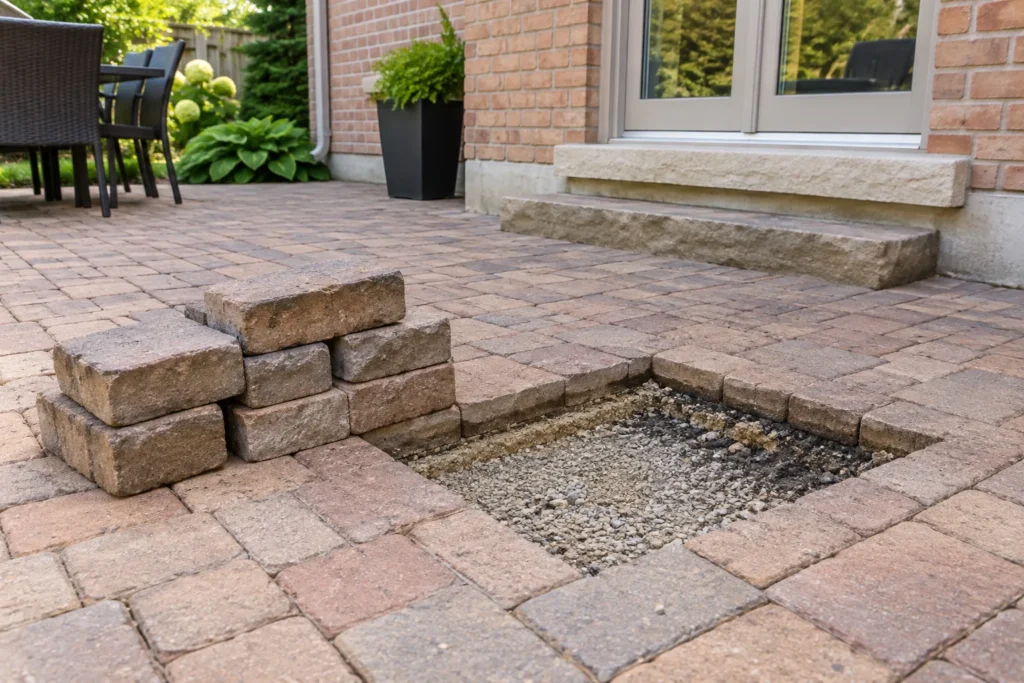
Insufficient or inconsistent support may occur across a newly constructed area, above an old utility trench or in a pocket that was disturbed during earlier work. If a trench crosses the paving, the settlement may trace its line. If only a small corner was excavated, the pattern may be irregular. The history of the ground can matter as much as the age of the blocks.
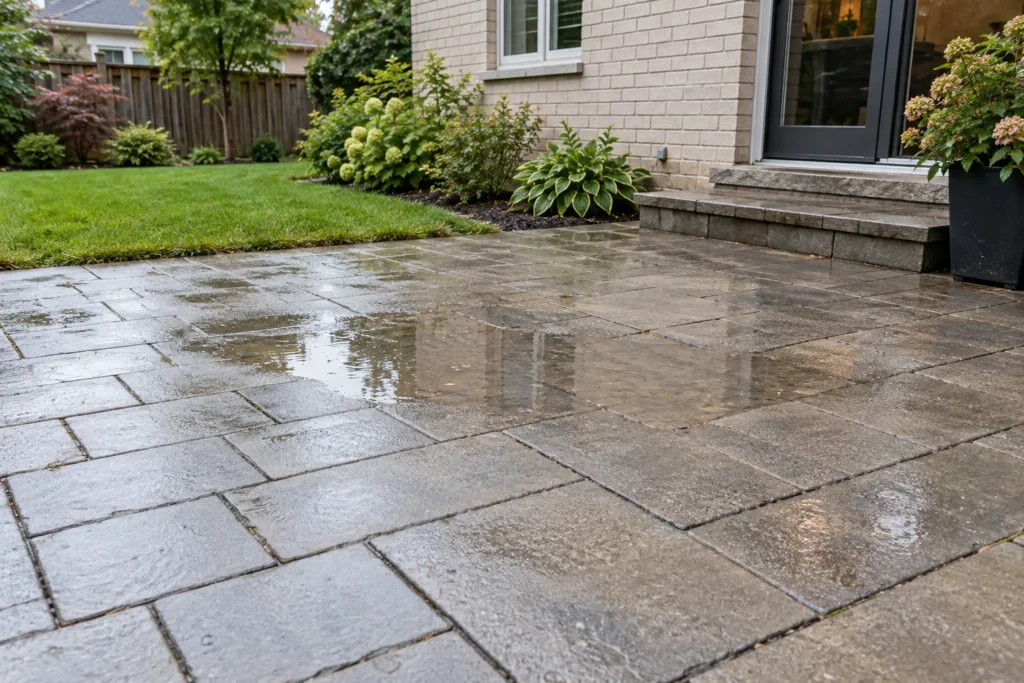
Water deserves equal attention. Persistent wet conditions, uncontrolled roof runoff or a route that concentrates flow through an edge can affect performance. A puddle marks a low spot, but it does not establish whether water created the low spot or simply collected after settlement. Inspecting the layers and checking how water leaves the area help distinguish these possibilities.
When pavers are lifted as part of an assessment, the condition below should be recorded rather than immediately covered. Uneven bedding, disturbed aggregate or soft supporting ground can change the scope. The purpose of opening the surface is to understand support and drainage, not merely to create space for a thicker layer of loose material.
What different symptoms can suggest
| Visible pattern | Questions it raises | What it does not establish |
|---|---|---|
| Ruts where vehicles repeatedly travel | Does the supporting construction suit the load, and is there underlying movement? | That the paver units themselves are defective. |
| A dip following an old trench | Was the disturbed ground reinstated consistently, and has it continued to settle? | The exact depth or length requiring correction. |
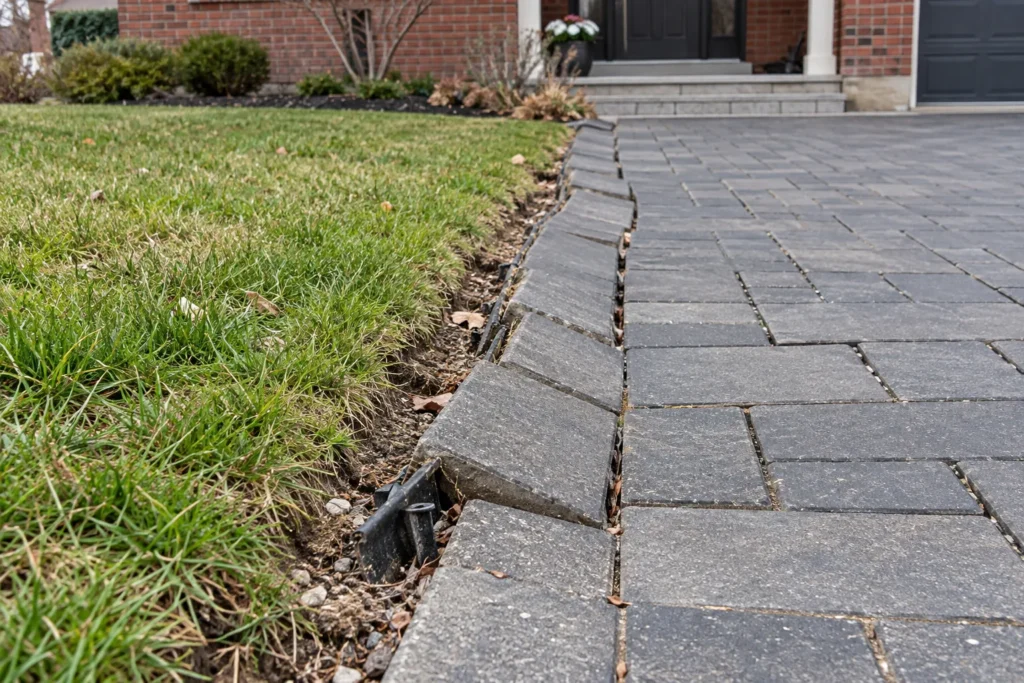
| Pavers spreading at a lawn edge | Is the edge restraint present, stable and supported? | That adding joint material alone will hold the paving. |
| A bowl that holds rainwater | Which levels control the outlet, and what is happening below the low area? | Whether the puddle is the cause or consequence of movement. |
| Unevenness beside mature roots | How are roots and the paved surface interacting? | Permission to cut roots or excavate beside a retained tree. |
Vehicle loading can expose a hidden weakness
An installation used only for walking has a different job from a driveway carrying repeated wheel loads. A paved area may also be used differently from its original intention: a parked trailer, loaded delivery vehicle or frequent turning near the garage can concentrate stress. Explain how the surface is actually used, including occasional access that is easy to overlook.
Repeated wheel tracks do not by themselves identify the failing layer. The movement may involve bedding, aggregate or the supporting soil. The visible pattern guides the investigation, while the construction and ground conditions establish the response. Rebuilding only the most obvious rut without understanding the adjacent system may leave the same weakness immediately beside it.
The fixed boundaries matter during any correction. Raising a driveway cannot block drainage at a garage or create an awkward step at a walk. A repair should be assessed against the surrounding levels, not simply made flush with the highest neighbouring block. Those connections help determine whether the issue is truly local or part of a wider surface problem.
An open edge can let an otherwise sound pattern move
Edge restraint holds the outside of the interlocking arrangement in position. Where restraint is missing, displaced or poorly supported, units can creep outward and joints can widen. The movement may begin at a corner or along a frequently used vehicle edge. Once the pattern opens, joint material may escape and the surface can become less stable.
Inspect the edge from a safe position and describe what you see: a widening gap, a border leaning toward the lawn or a transition that no longer meets the adjacent surface. Do not drive spikes into an unknown edge or dig beside it as an exploratory fix. Buried services, roots and the existing construction need to be understood before ground disturbance.
A decorative soldier-course border is not proof that the pavement has effective restraint. Likewise, a firm-looking concrete edge may have its own support problem. The visible finish and the concealed restraint are separate questions. Interlock repair should address the condition that allowed movement, alongside the final appearance.
Why topping up joints or sealing will not lift a depression
Joint material has a purpose, but it is not a substitute for a stable underlying assembly. Adding it to a settled surface may fill visible gaps while leaving the blocks at the same uneven elevation. Material selection and installation need to suit the pavement system; repeatedly adding a product without assessing why it disappears can conceal useful evidence.
Sealer changes surface treatment rather than rebuilding support. It cannot correct a low area, a loose edge or a faulty water route. Cleaning may make damage easier to see, but aggressive washing can also disturb joints. Ask whether maintenance is appropriate now or whether movement should be assessed first, especially where the area presents a trip or drainage concern.
A familiar approach to minor unevenness is lifting and relaying pavers. That can be part of a sensible repair, but its success depends on what is corrected below and beside them. Reusing sound blocks may be possible. Reuse should follow an assessment of their condition and the required system, rather than being treated as proof that the repair is necessarily small.
A technical reference for pavement distress
The Concrete Masonry & Hardscapes Association discusses rutting, settlement, edge movement and reinstatement in its operation and maintenance guidance. These are system issues with different possible causes. Site assessment should identify the distress and supporting conditions before selecting repair work.
Prepare a useful sinking-paver assessment
Collect a wide photograph, a close view and an angle that shows the connection to a fixed landing or doorway. Photograph the edge separately if it is spreading. Include a rain photograph when safe, along with a note about how quickly water disappears. Describe previous patching, utility work and any change in the surface since installation.
Identify the area where walking or driving is difficult, and keep people away from unstable or abruptly uneven sections as appropriate. Avoid balancing a heavy object on loose units to demonstrate the dip. An assessor can determine suitable measurements on site without creating an additional hazard during a photo request.
The next decision is how much of the system needs attention. That is a different question from why pavers move. The repair-or-replace guide compares local correction with wider reconstruction, while interlocking services covers new installations and connected layouts. Establishing the cause first makes that scope decision more meaningful.
Keep the history of earlier corrections
If the same area has been relaid before, explain what was done and how the surface behaved afterward. A repair that remained stable for years is a different history from one that settled again soon after completion. Include invoices, construction photographs or notes if available, without assuming they establish every concealed detail.
Describe changes around the paving as well. A new downspout extension, altered garden edge, adjacent excavation or different vehicle use can change the conditions after installation. The purpose is not to assign blame from a timeline. It is to avoid treating the visible dip as though nothing around it has changed.
Common questions about sinking interlock
Does all interlock have to sink?
No. Some movement can occur under changing conditions, but a growing depression, widening edge or troublesome rut should not be dismissed as inevitable. The useful question is what has changed in the support, loading, water conditions or restraint at that particular location.
Can roots make pavers look sunken?
Yes. Raised units above roots can create a relative low area beside them. Photograph the broader pattern and identify retained trees. Root-related work needs a tree-sensitive assessment; cutting a root to flatten paving is not an automatic or appropriate next step.
Can the same blocks be used again?
Potentially, if their condition and the proposed work allow it. Availability of matching units, breakage during lifting and the required layout can affect reuse. The reason for movement still needs correction, even when the visible blocks are suitable to keep.
What should I request first?
Ask for an assessment of the movement and its boundaries rather than specifying that a single dip be filled. Use Request an Estimate with photographs, a short history and the actual use of the surface. Those details help frame the concealed questions.
Published