
Burlington Landscaping
Repair or Replace Interlocking?
Compare localized paver defects with wider base, grade and layout problems before deciding whether to repair or replace existing interlocking.
A dip in an interlocking walkway does not automatically mean the whole surface has reached the end of its useful life. Equally, attractive paving stones can sit above a base that no longer supports the intended use. The decision is about the condition and function of the assembly, not simply whether the top looks old.
Start by describing what has changed. A settled patch beside a downspout, a spreading driveway edge and a patio that repeatedly sends water toward the house are different problems. This guide helps organize those observations, compare repair and replacement scopes and ask useful questions during an assessment. It does not establish the hidden base condition from a photograph alone.
Separate appearance from performance
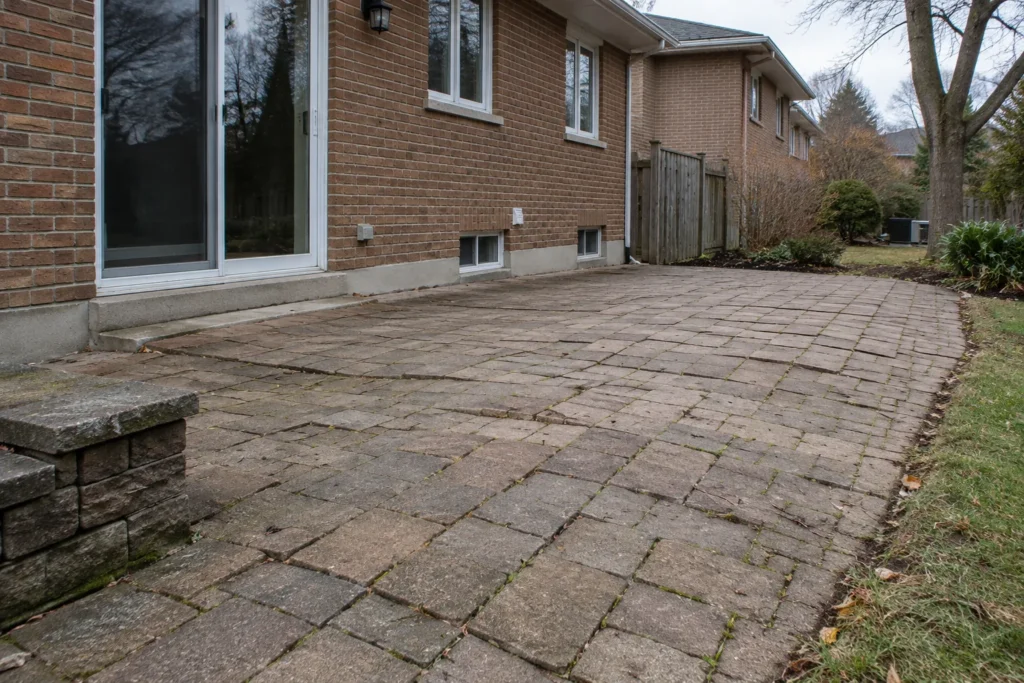
Walk the entire paved area and identify the actual inconvenience. Is the concern uneven footing, water collecting where people sit, a vehicle rut, loose edges, missing joint material or a finish you no longer like? Mark those separately on a simple sketch. Cosmetic wear can coexist with a sound structure, while clean-looking units can conceal movement beneath them.
Notice whether the issue is confined to one bounded location or repeated across the surface. A single depression surrounded by stable paving gives a different starting point from several unrelated dips, an undulating edge and changing levels at doors. Look at adjoining steps and thresholds without assuming they can be raised or lowered to suit the paving.
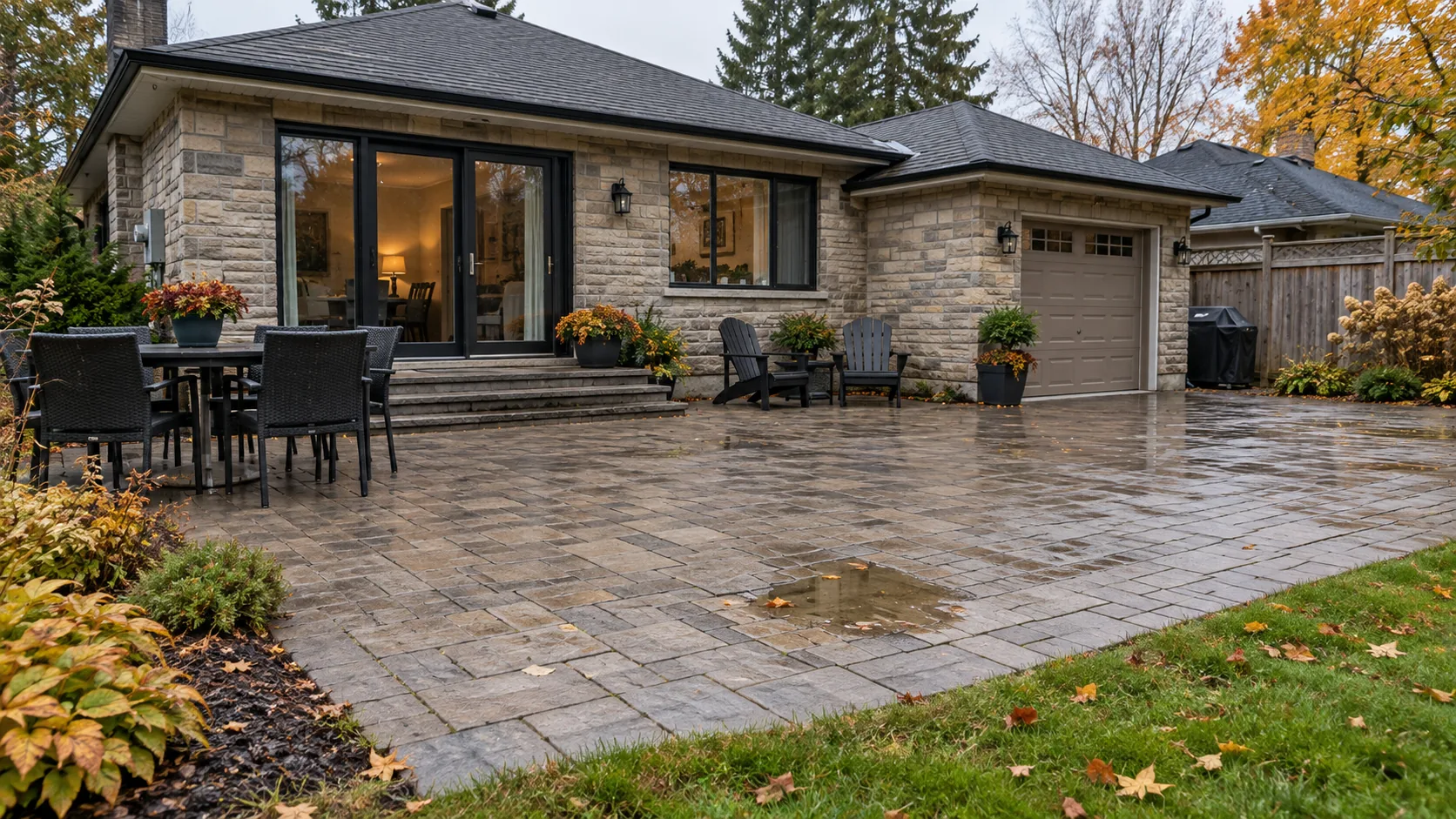
Photographs after rain can show where water collects, but dry-weather views help reveal edge movement and joint condition. Keep both. If a puddle occurs only when a downspout discharges heavily, include that outlet in the assessment rather than treating the paving as an isolated rectangle. The narrow article on why interlocking sinks explores common mechanisms; the repair decision must still consider the whole site.
What makes a localized repair plausible?
A repair is most promising when the problem has a clear boundary, the surrounding assembly remains serviceable and the required correction can be tied back into stable levels. Existing units need to be strong enough to lift, clean and relay. The original pattern, cuts and available spare units also affect what can be restored.
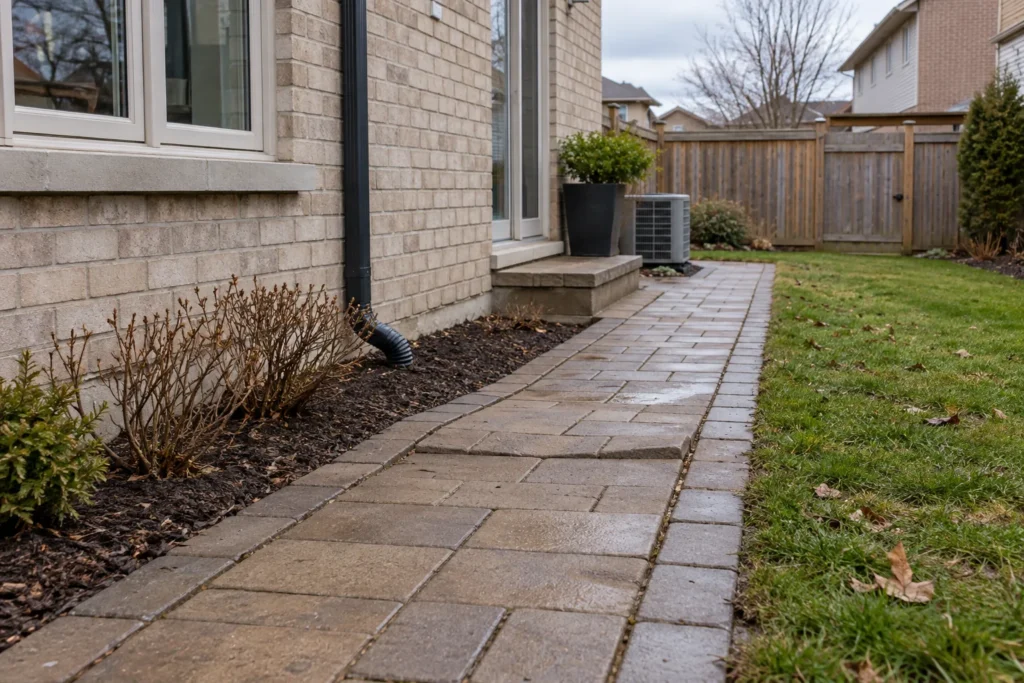
For example, a small walkway depression beside a leaking eavestrough may be approached by addressing the water source and resetting the affected area. That is a scope to investigate, not proof that adding bedding material alone will solve it. The assessment must consider what was washed out or compacted, the condition of the supporting material and whether adjacent units also need lifting.
Repair can preserve a useful layout and reduce unnecessary removal. It also has limits: aged replacement units may not match, fragile stones can break during lifting, and a repair boundary may remain visible. Ask how discoveries below the paving will be handled. A quotation should explain the assumed area, what supporting work is included and what would prompt a revised scope.
Read the whole assembly before choosing a finish
Interlocking depends on more than the stones. The supporting ground, base, bedding, edge restraint, joints and finished grade all work together. Resetting the surface without understanding why it moved can leave the original failure mechanism in place. A neat photograph of newly level pavers is not evidence that the underlying problem has been corrected.
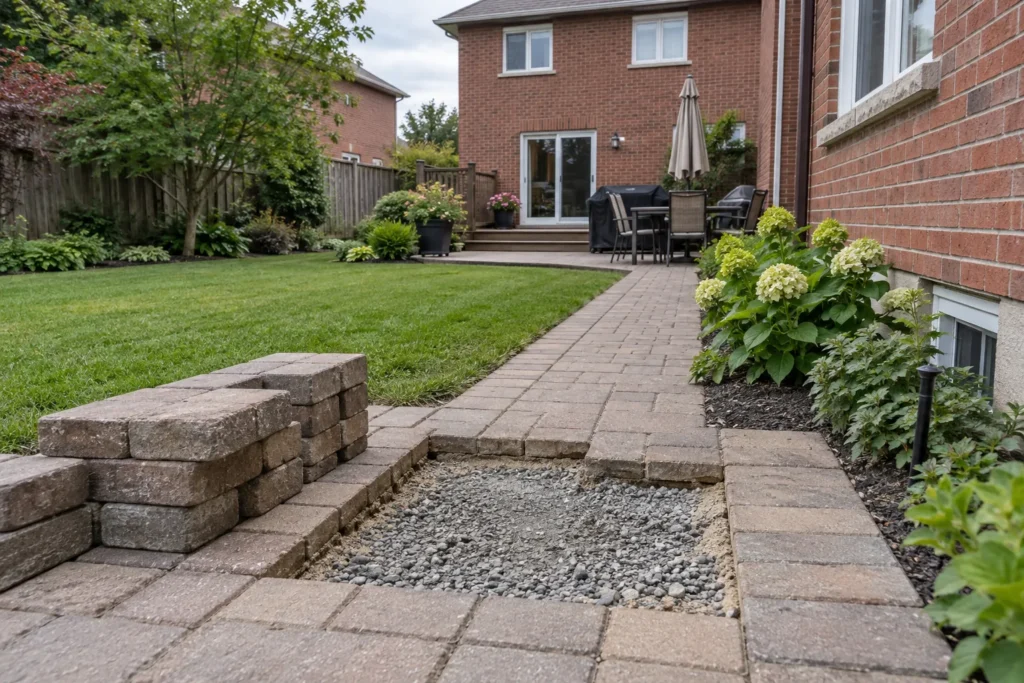
Where units have been lifted for a genuine assessment, examine whether the exposed area supports the proposed repair. Soft ground, contamination, displaced aggregate or a persistent water route can widen the work beyond the visible dip. Do not infer a universal base depth from what is exposed at one edge; the required construction depends on the use, site and material system.
Ask where the repaired surface will send water and how it will meet the retained surface. A repair that creates a new low point beside the boundary simply moves the inconvenience. If the intended correction requires broad changes in levels, compare a wider reconstruction with patching before agreeing to several disconnected repairs.
Compare the work each option actually buys
| Question | Localized repair | Broader reconstruction |
|---|---|---|
| Where is the defect? | A defined area can be corrected and tied into stable surrounding paving. | Movement, inadequate grades or support problems are distributed across the area. |
| Can the units remain? | Existing units are sound and can be lifted; matching limitations are understood. | Damaged units, an unsuitable material or a changed layout justify replacement. |
| What changes underneath? | The cause and supporting work within the repair boundary are specified. | Removal and reconstruction allow wider base, edge and grade changes. |
| What stays unresolved? | Age, appearance and retained areas remain part of the decision. | New work still needs coherent outlets, transitions and ongoing care. |
When a wider rebuild deserves a fair comparison
Repeated settlement, widespread edge failure or a surface that cannot drain properly at its present levels may make isolated resets inefficient. Another reason is changed use: a patio built for a small sitting area may not suit a new accessible route or larger outdoor arrangement. The existing assembly must be assessed for the proposed function.
Replacement is not automatically the only answer to broad movement. A discussion might include lifting and reusing sound units over a reconstructed base, rebuilding one complete zone, or changing a troublesome interface while keeping another. Ask for the practical boundary between those options rather than a simple new-versus-old sales comparison.
If the plan expands the paved area, alters a driveway or changes grades, review the wider property implications before ordering material. Replacement within an existing footprint and a redesigned hardscape can involve different decisions. Use interlocking installation for construction scope and the property-planning resources for access, grade and water coordination.
Cleaning and sealing answer a different question
Staining, joint deterioration and surface movement may be visible together, but their remedies differ. Cleaning can improve a finish; it cannot restore a failed base or remove a trip edge by itself. Sealing does not create edge support, correct a water outlet or make a settled walkway level.
Discuss structural corrections before committing to surface treatment. Cleaning a surface that will soon be lifted may duplicate work, and product selection should suit the paving material and actual condition. Existing coatings, stubborn stains and joint requirements need their own assessment. Avoid assuming every older paver will return to an identical new colour.
A useful sequence is to establish what moves, correct the agreed support and grade issues, then decide what finish care is worthwhile. The cleaning and sealing service covers that distinct maintenance scope. Keep its expected appearance separate from any promise about the durability of repaired construction.
Make two quotations comparable
Ask each proposal to identify the affected area and the retained area. A lower figure may cover lifting a few stones and replenishing bedding, while another includes a larger excavation, edge reconstruction and restoration of adjacent lawn. Those are different purchases even when both are described as interlock repair.
Record access, disposal, reuse assumptions, damaged-unit handling and the treatment of thresholds, steps, garden edges and drains. Ask what happens if lifting reveals unsuitable support beyond the quoted boundary. A clear variation process is more useful than an unsupported promise that no hidden condition will be found.
Choose an option against the problem you want solved. If the aim is safe access and dependable surface drainage, prioritize those outcomes over an exact colour match. If the layout is already wrong for daily life, spending on several repairs may delay the redesign you actually need. Bring that longer-term intention into the first conversation.
Questions before deciding
Can sound paving stones be reused?
Often they can be considered for reuse, subject to their condition, the ability to lift them and the proposed pattern and loading. Allow for breakage and limited matching stock. Reusing units does not mean reusing unsuitable support underneath them.
Does one settled spot prove that the entire base failed?
No. Its cause may be local, but the surrounding area still needs assessment. A useful recommendation explains the evidence for the chosen repair boundary and what would change that recommendation after lifting.
Should the cheapest repair be tried first?
Only if it is a coherent response to the problem and its limits are acceptable. A small reset that ignores the water source may be poor value. Compare what each option corrects, what remains and how likely later work is to disturb it.
Continue planning
Bring the property conditions into the conversation
Tell us what you would like to change, repair or maintain around your property.